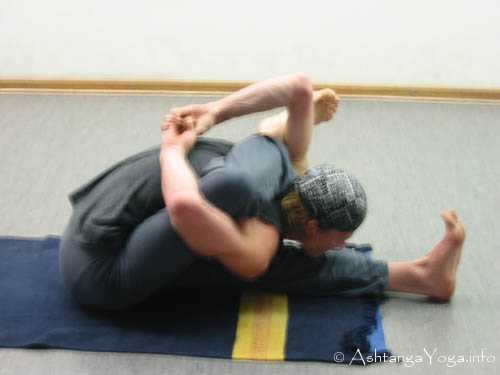
Friday, March 7, 2008

David Williams New York Ashtanga Yoga Workshop*

"You are enlightened until you think that you aren't."
-David Williams


(Photo from David's website http://www.ashtangayogi.com/)

Last night I attended the first night of David Williams' workshop entitled, "Ashtanga Yoga for the rest of your life" at Yoga Sutra NYC.

As people scrambled for floor space and David climbed up on to the makeshift stage/altar/podium, he overheard someone in the crowd mentioning chakrasana. "Did I hear chakrasana?" he asks. As he shifts the pillow behind him, he says under his breath with a smile (just loud enough for everyone to hear) that he wouldn't be teaching chakrasana or setubandhasana this weekend because he "doesn't want to take the chance of even one person getting injured". He emphasizes that when he was taught these asanas, he was personally and individually watched by Guruji (imagine!) who having seen him practice for some time, thought these would be safe. (As many of us have seen in classes, many people do these moves wrong and occasionally badly injure their necks.) He then adds that he felt that it would be irresponsible for him to have a group of 60 people of all ages and all conditions, most of whom he has never seen practice before, try this. And this is what the workshop is all about--doing yoga for the rest of your life. He jokes, "I'm 58 years old and hoping to live to 108...We are all just one injury away from ending our yoga." So, David asks, if yoga helps us live happy, long lives, then why would we want to get injured if that will prevent and discourage us from practicing?

I was surprised by how open, candid, direct, specific, and humorous David was. He was a far cry from the "conservative ashtangi" stereotype, but at the same time, has been a daily practitioner of ashtanga yoga and has stayed true to Guruji's original teachings. This got me thinking about why we are practicing and why ashtanga has at times such an ill-fitting reputation...

Below, please find some of my notes from last night. I've done my best to be as accurate as possible. (This info was updated on 3/10/8.)

"When people say I'm disciplined [to have been practicing every day for decades], I think about how as a kid you are disciplined when you are bad. I practice because I am fascinated."

The Notes
1. On pain & "openings":
Pain
David explains that there is no benefit in hurting yourself and that "if it hurts you are doing it wrong."
"Hurting yourself more won't make you hurt less."

Openings
"Openings" are injuries and are to be avoided.
"I hope you don't have any more openings," he says.
"The average person over 30 who practices daily will get about 80% as stretched out as they are going to get within about two years of practice. Stretching should be slow and gradual to prevent tears. One doesn't just keep getting looser and looser forever."

2. On what yoga is:
"I want everything to increase my prana."
The purpose of yoga is to increase prana which is the energy, vitality, and immunity.
Nothing decreases prana more than injury.
"The form of a pose does not increase prana, only correct breathing, mulhabandha and one pointed concentratrion do."
"Ankle grabbing doesn't lead to enlightenment."
"Yoga is consciousness, awareness, and sensitivity, not just putting your leg behind your head."
Yoga is about increasing prana (imunities to dis-ease) and feeling good.

3. On daily practice (even if you are sick):
There is a 24 hour expiration on the benefits of yoga, meaning that you have to do it everyday.
If you are sick, its good to move, even just a little, that, and to swim in the ocean. (Does the East River count?)
Instead of doing one long practice, you should do a few small ones.
If injured or hurt, it is also important to keep moving, unless of course, something brings pain.

4. On Mulhabandha:
"Don't be confused by that other book," I think he is referring to "Moola Bandha, the Master Key". He says that you just have to contract your anus and ladies, also your vagina. That's it. "This is the whole practice." He explained how to find mulahbandha by putting one hand on the belly and one on the sternum. Take a few breaths here feeling the breath in the body and not doing any bandhas. Then, contract your anus and vagina (if you've got one) and breathe. Notice that the low belly is firm. Re-establish the bandha on exhales. This is what you should do during the whole practice. He also said that people who have what looks like big guts are often just stretching out their belly muscles during practice and aren't applying the bandhas properly.

Still digesting the info from last night, but thought I should share some notes in the meantime.

To read more on David Williams (he is fascinating) please check the following links:

David's website http://www.ashtangayogi.com/ is an excellent resource. In it you can find his biography, info on ashtanga, his teaching schedule, etc. But you will also find articles, a q&a forum, and pictures of the entire system of ashtanga yoga as taught to him by Guruji. For those of you in Ontario, be sure to check him out! March 13 - 16 at Orleans Yoga Shala http://www.oys.ca/.

Guy Donahaye at Ashtanga Yoga Sangha has revamped the original Ashtanga Yoga Shala website to include a forum, videos (of the old shala, very cool!), and interviews with notable members of the ashtanga community. His interview of David Williams is one of many that he has conducted as part of his upcoming film project...
http://aysnyc.org/index.php?option=com_content&task=view&id=97&Itemid=160

"While you are doing your yoga, try to be a yogi."

*Edited on 3/10/8 with the help of none other than David Williams. Thanks!
Edited on 3/11/8.

Wednesday, March 5, 2008

Tittibhasana - A User's Manual

"Be careful what you wish for."
These are the words my teacher says to me with a smile as I stand there after practice, still shaking. Today I got Tittibhasana.

Now this is one of those poses (or clusters of poses, really) that I never EVER really thought I would be doing. I mean, there is always the fantasy of me floating through the air in fifth series postures, but I know that they aren't ever going to happen--except they did today.

I hung out in yoganidrasana as long as possible. Just breathing, hoping I don't know, maybe to hide? Yesterday Guy said that I'd get Tittibhasana today. "No new poses on Tuesdays," he laughs. All day I was thinking to myself how he is crazy and there is no way that that is ever going to happen. At the same time, he gives poses out about as frequently as Sharath, so if you get a pose, you know you are ready for it. Still, I was convinced I might break in half this time.

So there I am in yoganidrasana. I didn't get an adjustment, so I figured I might slip by. I did chakrasana, took a few breaths in downdog and then I heard it, "jump your legs around your arms." Its funny how you always know when your teacher is talking to you, even if it is across the room.
1.) How to jump legs around arms so they land high? I can jump them, but I feel like I can't get my arms deep enough under my thighs. Maybe I should just jump to handstand and then lower down from a straddle on Sunday. Yes, that's what I'll do, no problem.

5 breaths here in Tittibhasana (with pointed toes), then swing legs to the floor around hands.

2.) Feet were too wide apart. They need to be pretty close in to the hands. Maybe squeeze thighs together a bit more?

Then lock hands behind waist and look to navel without falling over. Don't know if my legs were straight. There was just so much going on. And I was laughing involuntarily almost the entire time. 5 breaths here. Then walk.

3. Figuring out how to walk was pretty challenging. The first steps were not steps at all, just little shuffles. Then, I got a momentum. Inhale step right exhale step left. My fingernails were digging into my fingers. My thighs were burning. 5 breaths later, I have to now walk backwards. By this time, I can feel the blood rushing to my thighs. I can feel them turning into jelly. I am struggling to recall the last time I was working this hard. I am covered in sweat. I think I lose my grip and come up for air. I say something like "oh my god!" And then dive back in to finish walking back. I can feel the whole class watching me, I feel like I'm giving childbirth I'm making so much noise. I complete 5 breaths and Guy says, "One more!". I huff and puff and take one more right and left step back. Then the feet come together. I stand up for air. My legs are useless at this point.

4. Saving enough energy to bring heels together, interlace hands around tops of feet, look to navel, AND not fall over. 5 very quick breaths and faith in a teacher later, titibasana. I sigh heavily, probably say, "THANK YOU!" again. I rock back onto my hands, lift my feet, struggle to lift my jello legs, bakasana, jump back. "Next time 5 breaths tittibhasana and bakasana and then jump back". I look at him and say, "That was so hard! You got me this time! I had no idea!" He just smiles. I lie down with all circuits firing. The rest is a blur in the wake of tittibhasana. Back bending, finishing, resting.
I never really thought I'd be doing leg behind the head stuff with confidence, but it is true, just a few weeks later and my neck is a million times stronger. After the initial shock wheres off, my muscles and mind will remember that these poses are possible. Slowly slowly.
Be careful what you wish for.
David Williams is in town for a weekend workshop. I've got a pass for the first night's talk which is not to be missed (and a bit of chat time for the magazine). This is also during the time I am supposed to teach a brand new class. What to do? Sub it out and make a totally bad impression? Teach it and miss out on meeting a legend? What to do?


http://www.youtube.com/watch?v=rWdO7RmTs5M

Oh, youtube, how I love you! This is a video I found on youtube posted by ashtangaboi. Enjoy!

Monday, March 3, 2008

Sick? No fever = practice!

The consensus seems to be: no fever equals practice. Since I look to my ashtanga practice as my medicine, I figure I should follow what the instructions on the bottle say... But, I also told myself that it I really felt like shit this morning (fever or not), I would rest, as I don't want this dragging on for weeks.
When my alarm went off, I did a little "check in" with my body. Vital signs good. Heavy congestion. Diagnosis? Hit snooze and move slow. Seven minutes later, I am convinced that although sleepy, I am feeling better and only congested. I take a shower. I do neti. Some yellow boogers and blood-speckled phlegm later, I eat some chywanaprash. By this point, I'm feeling okay. I bundle up and head out the door.

It is a nice day outside, and at 6:30am, it is getting lighter. About halfway to the subway I get dizzy and realize what the @#$% am I doing out of bed? But can't seem to turn my feet around. Too much effort to change mind. Get to subway station. Hips hurt. Wait for train slumped in a seat. Debating whether or not to call a cab. Train comes. Get on. Reassure self that it is okay. Take bus to shala. Walk through park. Wondering what to practice. Second only? Modified? Not really caring either way. Feeling like I'm sitting inside an egg shell, looking at the world through a lens. Get inside. Feeling ok.

I'm late, but don't really mind as I'm not concerned with getting a new pose or adjustments. Start sun salutes and really get into it. My breathing was so comforting. It was like soft pillow breathing. At Trikonasana, teacher tells me to just do primary. Awesome. Went slow, full, deep breathing, got really sweet adjustments, it was such a soothing, soft, pillowy practice. Back bends were shit, but didn't expect much anyway. Felt good to just take it easy. Relieved that I didn't practice second. All the back bending? Yipes! I'm used to primary. It doesn't really shock my body like it used to. Now, it is like an old friend, a security blanket, my favorite food. My body knows what is coming, and invites it in. Second is getting there, slowly. There are some points, however, where a joint feels gummy, and I've got to breathe through and my nerves are all firing at once. That's why I'm relieved I didn't practice that today. Being sick, I've got that feeling already. My spine, the back of my neck, my shoulders, my right elbow, my hip, my knees, all gummy and achy.

I didn't even break a sweat. I got up and rolled up my mat like I had a good soak in the tub. Bundled myself up, headed out still congested, but feeling better. Yoga magic!

Sunday, March 2, 2008

Should you practice ashtanga yoga if you are sick?

Maybe it is like ladies' holiday, you take the first three days off to rest. Or maybe you just keep practicing and sweat it out.

Personally, I feel it is inappropriate for an ill student to attend a class as this exposes others to the possibility of getting sick as well. Plus, its gross practicing next to someone spitting loogies into a tissue. That said, should you practice at home? Will it actually help you get better, or will it just help you keep up a "routine"?

I searched the internet for answers and I invite you to share your understanding of the topic!

In a humorous post (10/25/07) about conservative versus liberal ashtangis, CRON yogitect notes that the conservative will "do primary series when they are sick, unless they have a fever."

In the ashtangayogi.com article entitled "I Ain't No Doctor", Charles Pan shares his notes from a workshop he attended with David Williams. On illness, David suggests that if you are sick, you should "...start with the sun salutations, doing three of each and then getting in bed and covering up to hold in the warm healing prana. Repeat throughout the day. "

Again, in Alan Little's blog, he mentions that David Williams said that he "'never missed a day’s yoga practice in thirty years'. Williams says skipping practice when you are sick is exactly the wrong thing to to – that’s when your body most needs to be energised and cared for by yoga practice. That doesn’t necessarily mean two hours of heinously advanced asana contortions though." ("Ahimsa" 20th July 2005)

In the FAQ's at theyogaroom.co.uk, Abby Hoffmann recommends that students should come to class to practice "if you are only mildly ill". And that indeed, "it may be helpful to practise. However, if you have a temperature and/or your energy level is depressed, practise real yoga: respect your body and rest. If you’re up to it, you could try a gentle restorative practice at home, using blankets and bolsters (there are lots of books with suggestions for passive, restorative postures). Consider others as well, no one will think any less of you if you not at class for reasons of illness and also keeping your germs out of the shala!" (This same info is listed on


Okay, so nothing really definitive. Plus, not all sicknesses are created equal. Do you do the same for the flu as a cold? What about food poisoning? Menstrual cramps? A migraine? Constipation? Bronchitis? Pneumonia? I await the answers!

And is your flu really the flu? I've heard of and experienced "back bending fever", which is usually a 24 hour flu after some intense back bending. Additionally, it is not unheard of for people to get sick during times of intense practice:

"Other mild to stronger symptoms of purification will begin to appear for most practitioners. It is very common to see the increased occurrence of colds and flu and fevers, as well as, headaches, drowsiness and light-headedness. It is important to honor and respect these kinds of changes, as they can be quite deep in one’s system. I recommend that you take extra time to rest and be quiet." (Govinda Kai, Ashtanganews.com, "Ashtanga Yoga and the Path to Purification", November 29, 2006.)

Hmm. Yeah, but I think this is just the flu, flu. I am around many different people every day, I ride the subway, everyone around me is sick. I got sick too. I am not going to the shala today to spare my fellow practitioners, and I might do a couple of sun salutes. I'm going to take the day to rest and hopefully recover before tomorrow. For me, I feel like its better to just rest and get over it (3 days max) and then back to practice to work through anything that's left. But that's me.

Saturday, March 1, 2008

Yoga Chikitsa: Led Ashtanga Primary Series

As I was completely absorbed with publishing the new magazine (check it out at www.livingmysore.com), I did not have time at all to practice or do anything else yesterday. So today, before attacking that overflowing pile of stinky laundry next to the computer, I broke out Sharath's Primary Series CD and went to Mysore for one hour and fifteen minutes.

I bought this CD a couple of years ago while I was doing an intensive over at the Ashtanga Yoga Shala so that I could learn how classes are really supposed to be counted. After having been in Mysore, I can honestly say that this is an excellent way to experience a led class the way it is taught by Sharath. I really learned how ashtanga teaches us to use an economy of movement; to really move with mindfulness and place things exactly where we mean to place them. There is also no room at all for thinking because you are listening so carefully for the next vinyasa count. It is just so precise in its simplicity. I just love it!

I haven't practiced with the CD for a while, but I remember that when I first got it, I was struggling to keep up in headstand and upluthih. So you can imagine my surprise when I could stay up this time! Slowly, slowly...

I did practice at home, however, which has its drawbacks. The first being that it is really cold (but not cold enough for me to rationalize turning on the heat, which we pay for). Well, actually, that's the only drawback. It is cold energetically and physically. Part of what gets me through practice is the community.

And after sitting at the computer ALL DAY yesterday, I was so achy today. It makes me feel very worried for all those stuck in front of a computer 9-5. This is not how we are supposed to live!

Also, because it was laundry day, I had no proper practice clothing left ie a reliable sports bra. This really changes practice. More on this and teaching the led primary later...

Thursday, February 28, 2008

The Splits

Semi, half, no split. Which is it? It seems there is no simple answer.

First, what is "the split"? When practicing mysore style, you learn first series one pose at a time. At a certain point, perhaps your teacher will decide that you are ready for the next pose which, if you are practicing a satisfactory primary up to setu bandasana, would be pasasana--the first pose of second series. So every day, you would go do your primary series practice up to pasasana, and then maybe you get another pose, and you continue like this, adding poses onto the tail of primary until one miraculous day when your teacher splits your practice. This means that you only have to practice one series--second. Then you would go on practicing second series adding a pose now and then until you practice all of second and then you get third series postures tagged on the end. You continue adding poses to a certain point and then your teacher gives you the split this time for third series only.

In the case of the second series split (practicing only second series), you would still practice primary on Fridays. In Mysore, you might also practice primary on Sundays. This is because Sundays are the "led" days. If there aren't any second series led classes offered, then you practice first.

But the question remains: at what pose will I get spilt in second series? There are many answers. The current trend in Mysore is getting split at eka pada sirsasana. However, one must wonder if this is on a case by case basis, if this is a time and space issue, or if it is "official" policy. I've spoken to a few teachers and students on the subject, and answers vary. Some of the older teachers say that back in the day, Guruji had them practicing both first AND second series until they got to the first pose of third. I didn't hear what happened after. Others say that "past generations" were split at karandavasana. Still others recommend doing a "semi-split" until karandavasana. In this instance, one would practice the first half of primary one day plus second series asanas, the second half of primary the next day plus second series asanas, and back and forth all week.

The main reason for the longer wait for the split seems to be developing and maintaining strength for karandavasana and third series. So then why split earlier at eka pada? I've heard there have been other changes made to the practice over the years, though the reasons are hazy. I've heard there was a second variation of lagu vajrasana, for instance. I've also heard drop backs didn't happen until well into second series, instead of as the final trial before second. I've also heard that hand mudras were okay in the past, but now they aren't. Not that any of it matters really I suppose.

On my split:
I am pretty surprised at how sore my arms are and how quickly my neck is growing stronger. I figured with second series only I'd be having it easy. Not so! Perhaps it is the belly back bend/upward dog transition or some other new muscle groups being developed...And indeed, my neck is getting much stronger by the day. I remember on that first day, I had a little voice in the back of my head that was convinced my leg would push my head right of my shoulders. I am looking forward to primary tomorrow. All the forward bending is calming and soothing for my back. Plus, its a nice way to end the week.

Wednesday, February 27, 2008

The Indian Way

Before I went to India, I was very concerned about the hand policy. Left, right, right, left, how would I remember? I tried to sit on my left hand while I ate, and was shocked when I reached for toilet paper with my right. But once in India, the problem was not a problem at all. In fact, toilet paper available or not, I very easily I appreciated the comfort of having a "clean" and a "dirty" hand.

Back in my apartment post-India, it took me a few days before I realized that in the west, its not that people don't care about being clean or dirty, its that this is a righty's world. I've been making mental note of this. Almost every WC I encounter had the toilet paper roll to the right of the toilet, whereas in India, it was mostly on the left. This must be particularly traumatizing to those who grew up with a dirty/clean hand policy. So do lefty's wipe left? That's quite a reach around. Do you just use the hand closest to the paper?
On the Tyra Show (I know, I know), Tyra gave western toilet squatting lessons to a post surgical woman. (Man who is now woman.) She definitely told her to wipe right.
I digress.
After some initial turbulence, practice today was smooth sailing. I seemed to have "proved" my second series worthiness, whatever that means. Had some hinting towards the next pose coming tomorrow. I'm a bit scared. This is uncharted territory I have a hard time believing that that stuff is possible for my body. Swaha.

Tuesday, February 26, 2008

Good housekeeping

Doing some early spring cleaning on the site so I can start writing again....

Mysore tips from my first trip 2007

Mysore Travel Tips

This is by no means a definitive list, but it does include all those little things which I had no way of knowing before actually being in India.

1. Floss. I haven't gone looking for it, so I can't say for sure if it is always in stock, but who wants to go out and buy floss? Just bring some with you!

2. Ladies, don't expect to find undergarments to your liking in the shops here. Bring bras that you like with you and if you aren't a fan of the granny panty, you ought to bring your own undies as well. That said, there is a jockey store on Devarajurs Road...

3. Did I mention grapefruit seed extract? Yes? Well go buy some right now!

4. you might miss magazines. there are local india mags, but I know I'd like to get my hands on a NY Times or Discover Mag, or Rolling Stone. Anything! Even if it was three months old. My recommendation? Bring em with you!

5. you can find tampons here at the local grocery store called Nilgiris, but they aren't organic (if you're into that sort of thing).

6. vegans: you need healthy bacteria in your belly. plan on either eating curd or taking supplements (but you'll need to bring them from home).

7. You'll be really happy if you bring veggie bars like the ones by odwalla or the green veggie powder you add to water. Yes, there are veggies here, but I know a lot of us are craving more!

8. join facebook. just do it. I didn't want to either, but it is a great way to keep up with people around here. emailing can be so tedious!

9. I can almost guarantee that at some point, you will have diarrhea. better not to think about it too much.

10. You'll start to miss variety if you don't bring plenty of clothes. The paper bag look doesn't work for everyone.

11. Mysore is a lot like life. It is part what you make of it and part what it wants to give you.

12. Try to bring clothing that has lycra or something like it. From hand washing and no dryers, you'll find most of your clothes will grow, grow, and grow.

13. Avoid talking politics. Yoga, that is. Some people are open about different views and opinions, but you might catch yourself with your foot in your mouth.

14. Almost everyone gets sick within the first 2 weeks. See Anu and Ganesh. They'll make you food that will help you feel better.

15. Bring or buy mosquito repellent. why suffer?

16. Lots of people have wifi at their houses and in local restaurants. You might want to bring your laptop. Plus you can use it to watch movies! Its like college all over again!

17. Bring loads of yoga clothes.

18. Bring lots of things to make yourself feel fresh. I didn't really bring anything. You can buy a lot of stuff here, but not necessarily things that you like and you don't want to spend your trip here feeling like you are camping!

19. Buy electrical adapters when you get here. A simple one costs 12 rupees at Loyal World.

20. Seriously consider how much you need your jeans. You'll be hand washing them.

21. If you are picky about toiletries, you should bring your own.

22. Pack grapefruit seed extract

23. Don't under any circumstances hand over money for a room until the said space is EXACTLY how you would like to live in it!

24. Only pack shoes that slip on and off. It is better if they don't have backs because you will be constantly taking them on and off everywhere you go.

25. Savor your last shower before heading for the airport. It might be some time before you have a shower like that.

26. Bring toilet paper, wet wipes, and hand sanitizer. Toilet paper is available in mysore, but you might want to have an emergency roll on you, just in case.

27. Nobody gets shots. Really.

28. It is really easy to get a car to pick you up from the Bangalore airport. The guy Krishna that they list on the ayri website really will arrange this for you.

29. Take the flight with the shortest layover possible. It is ok if you arrive in Bangalore at a weird time like 3am.

Transfer student

Ever change schools as a kid? I went through it a number of heart wrenching and painful times. Just when you start to get some momentum going, you've got to pick up and start something new.

Well, now I am the "parent" and I'm going to go back to posting on:
www.mysoremusings.blogspot.com. Why? It just makes sense to me I suppose. Please continue reading there and I promise to dive back into writing!

My heart is in mysore

I just picked up this book on successful blogging at the local library (my favorite haunt). Happily flipping through the pages as I chomped down a particularly delicious (although inappropriate ayurvedically [is that even a word?] for winter and my dosha) salad with homemade ginger carrot dressing (yum), my eyes landed on the "top 10 dont's of successful blogging". Number 2, "don't let more than 3 days pass between blogs". Oops.

Well, the truth is, I didn't know if it was right to continue writing in this blog, since I was between mysore engagements and all. But I figure now, what the hey? I'll be there again soon enough and perhaps "living mysore" is all in the mind.

What's new? Russell and Sally left New York, and Guy is back at the shala. I'm curious to find out what he's going to say about my practice. You see, Russell has had me working up to yoga nidrasana and doing the "split" (which means practicing second series only). For some reason, it feels like I'm cheating or something because Guy didn't give it to me. He's going to come back and be like, "Really? Is this what you've been up to?" Its just poses, I know. But who is the one that has to let go? Is it me? Should I be like, "Okay, whatever. I'll go back to whatever I was doing before." Or is it my teacher's turn to let go? Or, does it really even matter? Maybe because I feel like I'm having fun (loads of back bending will do that for you), I feel naughty.

Anyway, I'll be in to practice tomorrow, so we'll see!

Since I've been away, I've been keeping up another blog:
www.ashtangainspired.blogspot.com. But, I think I'm going to post here mostly from now on.

Sunday, February 24, 2008

A Look at Yoga Teacher Trainings and Immersions

You saw the flier on the front desk, you saw the ad in Yoga Journal, you heard your yoga buddy talking it up and now you're asking yourself whether or not it's time for that teacher training. Whether you want to teach or simply want to deepen your practice, teacher trainings can be an excelent opportunity to take your understanding of yoga to the next level. But how do you choose the right program for you? How do you know when you're ready? Read below to find out!

Why do you want to take a teacher training?

Ask yourself why you want to take a training. It is important to consider your motivations before you make the leap. I mean, it's a nice fantasy--waking up to meditate on your little pillow, walking to your first class of the day still smelling of incesnse, teaching a class full of happy faces, hearing and seeing how much you're helping to better people's lives, etc. But do you actually want to teach? Teaching is hard. It takes a lot of energy and patience. You have to touch people and some people smell and have skin problems and boogers and swet. You have to speak in front of groups of people which is one of the number one fears. You have to maintain your own practice and continue learning to become a better teacher (it's not just take a teacher training and you're set).

Do you expect to teach full or part time? Will you be able to find work? Based on a number of interviews and personal experience, yoga teachers start off at a much lower rate than they anticipated. When you're just starting, you might not be able to find any work at all or only volunteer jobs. It sucks but that could be your reality. Plus, it's performance-based. If your classes aren't making money, you won't be either. Yoga studios are businesses. Some new graduates get jobs and well paying jobs right off the bat, but that may not be you. Studios usually look for expereince and possibily someone who has completed a 500 hour teacher training. They may be looking for people who have een to INdia once or even a number of times. So, unless the style t=you are interested in is a niche market where you'll be the only teacher and no competition and in high demand, don;t quit your day job just yet.

Perhaps you'd just like to deepen your practice and understanding of yoga? Most 200 hour teacher trainings serve to get the students to the practice level of a teacher. If you really want to work on actually teaching, you'll have to continue your education after the 200 hours.

Are you ready to take a teacher training?

Some progrmas require participants to have a daily practice, or even a practice history of a certain minimum number fo years. SOme trainings require you to be a student of their school for a certain amount of time. Other trainings have physical requirements such as the ability to perfrom a handstand in the middle of the room. Still others have reading requirements. It's a good idea to inquire as to what the program you are interested in requires and get on it right of way. All that said, what is most important is a strong commitment to your own practice. You should be practicing (asana or other physical exercies) at least 4 times per week. You should me working on practicing the other limbs all the time. Don't know what the eight limbs are? Go get a copy of the Yoga Sutras, every teacher training requires you to read them anyway.

What style should you do your teacher training in?

This is a very important consideration. If you aren't already rooted in a particular tradition, start dropping into as many classes as you have time for, expecially those offered at the schools offerring trainings that you are interested in.

Some styles to check out:
(This is just a sampling of the many types if yoga out there)

In the tradition of Krishnamacharya
Ashtanga--Try both a led and a mysore class. Watch Ashtanga, NY. Visit ashtanga.com. Read Yoga Mala.
Vini--as taught by Desikachar. This is not the same as vinyasa yoga. Get the Heart of Yoga by TKV Desikachar.
Iyengar--Watch the Estes Park Iyengar Workshop DVDs. Pick up a copy of Light on Yoga.

Other traditions
Kundalini
Sivananda
Integral

"Second generation" styles
Vinyasa-Could be a mix of any of the above styles.
Includes Forrest, Power, Jivamukti, Laughing Lotus, Om, Siva Rea, Sean Corne, Yoga Works, Anusara, hatha.

My opinion? Either go with a teacher you love, a style you love, or go straight to the primary sources.


What should you look for in a training?
Length
Adjustments
Anatomy
Personal Practice
Practice Classes
Observed Teaching
Assisting

recommendations
Yoga Union-A lot of information. Vinyasa with a heavy emphasis on alignemnt
Ashtanga Yoga Shala-well rounded program. However, to be authorized you have to go to India.
Anusara Immersion-great way to dive in without commiting to a full program
Centered Yoga-go to thailand, immerse yourself for a month.
Laughing Lotus-have fun.
Jivamukti-be a crazy hippy eccentric.

Remember that 200 hour isnt the end all. You'll finish your program either over confident or completely lost. Just remember that you teach what you know, focus on your own practice, and keep learning!

Did I miss anything? Do you have any other advice or feedback? Let me know!

Tuesday, February 19, 2008

Gasping and Grasping Poses, Air, and Ankles

The other day after practice, I was walking and talking with a fellow student at the shala. At one point she mentioned how that in ashtanga, there is no room for grasping because there will always be something to attain. This made me think for a moment of my own practice and experience with yoga. In terms of asana, I am about half content to practice whatever my teacher tells me without thinking of what's up next and half can't wait for the next thing. I saw someone doing a pose from fourth series and thought to myself, "do i really need to do that to be fulfilled?" Anyway, she's right. There is always something. There is no room for grasping with ashtanga.

As a teacher, it is very difficult to explain this to a student. Especially a New Yorker. The worst is when a brand new mysore student is given a "cheat sheet" of the series. This only implies to the student that they must learn this entire sequence, and instead of feeling that they are right where they need to be, they feel like everyone knows the entire sequence besides them. Additionally, it takes away from the student teacher dialogue. The student looks to the sheet constantly instead of looking to the teacher for help. At this point I wonder why someone is in class at all and what exactly they expect the role of the teacher to be. I think that cheat sheets can be helpful in some situations, but they aren't necessary. And anyway, these sheets don't teach you alignment, or other subtle aspects of the practice.

It is almost impossible for most beginners to be completely objective about their practice and where they should be in primary series. I mean, they are beginners! Mysore is taught the way it is taught for a reason. each pose leads to the next. You master one before another to avoid injury and to practice what is appropriate for your body, not your ego.

Let's say fine, a person has this sheet and decides they have "completed" first series. Do they then demand a second series sheet by which they haphazardly attempt all poses at will? Yikes! Obviously this is not impossible. There are plenty of videos and books out there. But I think most people would agree that it is better to practice under the guidance of a teacher to avoid injury.

So there is this particular student of mine who is actually probably my best student. He comes in every day with one of these cheat sheets and throws himself around doing whatever poses he feels like, in no particular order, of course. I've finally convinced him to slow down and work on standing postures, but even then, he focuses on "mastering"each posture. For example, in utthita hasta, the man can barely balance, breathe, and hold a drishti, and yet insists on attempting to fold. In one recent instance, I decided he was probably stable enough to give a little bit of assist here. Wrong. This gave him enough confidence to again try to fold, swing his leg about, forget drishti, grasp the air with flailing limbs, and punch me in the face before hitting the ground himself, pretty hard. Hmmm.

But, sometimes punching the teacher in the face and hitting the floor hard is what it takes to give in. Swaha. He came in the next day, without a cheat sheet, ready to listen and actually, he turned out to have a very mindful practice.

And then there are the ankles. I think I finally found out what that body block was that I was trying to exorcise in mysore (check my blog http://www.mysoremusings.blogspot.com/) -- it was an aching heart. This realization came to me on Monday. I don't usually talk relationships... My significant other and I had a big fight Sunday night. A big one. The kind that sends someone to another room to sleep. My practice on Monday was heavy, achy, tight, and the left side of my chest was incredibly tight and sore. When I went for ankle grabbing, never have I felt such a sensation. It was as if a squirrel had built a nest and was hibernating in my chest.

The rest of the week was not so bad as Monday, but now that I notice it, it is hard to ignore. Does love live there? Or does heart ache live there? And when you are in love, doesn't that ache, even when it is good?

So Sore (the 5:30am pre-teaching and practicing post)

This week I got yoga nidrasana from Russell. I was a bit surprised, actually. I suppose I'm always surprised when I get a new pose.

The other night, I had browsed through my copy of Iyengar's Light on Yoga, and under eka pada sirsasana, the thing that really stands out is his comment on how in this pose you really realize how hard it is to get a leg back behind your head and keep it there. When I saw people doing the pose in the past, they always looked so serene, now I understand that they were concentrating on a lot of different things at once. For instance, you have to get the leg back there, plus you have to find a sweet spot where the leg can rest and not fly off your back. But, you also have to be able to fold and to do any of this, you have to be able to hold your head up.

For someone that reads constantly, I am discovering all the underdeveloped muscles in the back of my neck. It doesn't make sleeping particularly pleasant, but I'm hoping that its going to do wonders for my posture.

Next comes dwi pada sirsasana. Its not the legs behind the head part that is hard, its the lack of strength in my neck. After all the work in eka pada, I've got very little left to give dwi pada. I wonder how long it will take to get stronger? I think the first week the body is like "cool, I can handle this." The second week, it has used all its energy and that is when the real body changes begin.

Yoga nidrasana is great because gravity helps your head to weigh down your legs.

In a rush, off to teach...

Monday, February 18, 2008

2 Kinds of Savasana

I should probably look this up, but I remember learning that in ashtanga that bit on your back at the end is "resting", not "savasana".

So I was "resting" last week at the Shala when I realized the difference in my practice. Last week I got eka pada sirsasana and dwi pada sirsasana and my first taste of practicing second series only: the split. But it was on Friday that I noticed the real difference in how I felt.

I had practiced primary feeling at once relieved and comforted as well as completely exhasuted and sore. Once I reclined for resting I was amazed at how unbelieveably soothing it was. The whole week I had to practically force myself to relax, despite how much I ached to just lie down. The difference is in the savasana.

Tuesday, February 5, 2008

My worried shoes

"One day I looked around and found the sun shining down and I took off my worried shoes"
-Daniel Johnston

I think that I can finally say that I have gotten used to waking up before 5am to teach and practice. It is painful and hard to believe when it is happening, but I came to the conclusion that even when I sleep in, I don't hear birds singing and squirrels aren't trying my hair in bows, while bunnies bring me tea.

I walked in to teach this morning and paused, looked around, and realized that what was completely throwing me off was that there were only men in my class. About a minute later, a female student walked in, did the same double take and was not at all sure as to where to put her mat. In Mysore, I really feel that most of the time, the male to female student ratio was usually equal. Sometimes the numbers swung one way or another, but in New York, it is almost guaranteed that there will be mostly ladies in class. Just thought that was interesting.

After I taught, I headed downtown to the Ashtanga Yoga Shala to practice. Russell was teaching (I'd really like to practice with Sally but don't know when she's teaching). Practice was going on and on and I noticed other people stopping early in primary to start second and faught back pangs of jealousy. Its not the poses that make me ache, so much as the time. After class, Russell mentioned that in the past, people got split at Karandavasana, which means that up until they "get" that pose, they would practice full primary AND second series up until that point. This would mean a two and a half hour practice! Getting split means that once you get karandavasana, you could save primary for fridays and just work on second series the rest of the week. Now in Mysore, I noticed that they are usually splitting people at Eka Pada Sirsasana. I wonder if it has to do with time and the number of students that are going.

When I got to Bakasana B, I gave it 2 strong tries but slid down, and on the third, I stuck it. Feeling satisfied, I jumped through for backbends and Russell walked over to give me bharadvajrasana and ardha matsyendrasana. Unique to ashtanga is that feeling you get of a new pose. It is like Christmas. Physically, your body is so used to the patterns you usually make, that the new movements are like crack. Mentally, you feel so giddy you want to drunk call all your friends, family, ex-bosses, 411, etc.

43220030
http://thumb6.webshots.net/s/thumb2/7/52/80/144775280PzGeDf_th.jpg
The picture above is from a really great set of photos of people practicing led second series at AYRI Mysore. Here is bharadvajrasana.
This picture of ardha matsyendrasana is of Bill of
absolutelyashtanga.com.

Friday, February 1, 2008

I give in: on practice

You might say that recently I've been a bit of an ashtanga tourist in New York. Guy is in Mysore and I'm short on cash, which leaves me either practicing at home, on good days with friends, and making the occasional drop in. In the last three weeks, I practiced with Greg, Amy, and Christopher at Yoga Sutra, and then with Russel at Ashtanga Yoga Shala.

Practice is never the same. Each teacher fills the room with a totally different feeling. Or is it the students who gravitate toward a teacher's particular teaching style? Or is it the students who are able to make that particular time slot? Or perhaps the fact that I was in one class in the afternoon (practically barfing up my lunch), the other in the early morning, the next after already teaching, etc.?

With Greg:
Students have always told me about Greg and how they love that he'll be adjusting you while he chants in your ear. As such, I feel like I missed out on the "Greg experience". Perhaps he already finished, but by the time I showed up, there was no chanting. There was a packed, sweaty room, however, where I spied a few people I knew from way back at Guy's and some people working on third series. It seems that people who practice with Greg take their practice very seriously, and many were willing to follow him when he moved from teaching all the way on the Lower East Side at Shiva Shala to Bryant Park's Yoga Sutra. He was nice, friendly, but I didn't get any adjustments. So, I guess you could say it was just like being in Mysore, and for that, I give it a thumbs up :)

With Amy:
Amy teaches mysore at Yoga Sutra in the afternoons. Although it is hard for me to motivate to practice in the afternoon, I often find that when I am able to focus and set down my mat, I am very open and playful. Which is why I wasn so very disapointed to almost be barfing the whole time. I didn't start practice until 5pm, having eaten at noon. I guess I am just so in the habit of morning practice at this point. Amy was really working the room, giving people tips, adjustments, and pep talks. I was impressed! And for such a small build, she coudl handle her own with really big people.

Christopher:
I have taken his classes in the past and have found them to be a bit "academic", but this time I really felt a lot of humor, which was very surprising. The best was when I was in kapotsasna and through my peripherals I could see a shadow looming. I think it was him checking my drishti. It was just so sweet!

Russell:
Russell is teaching at AYS while Guy is away. I found practice with Russell to be so completely relaxing. For instance, in Kapotasana, I was at my MAXIMUM, desperately trying to find space where there was none, then up walks Russell. He grabs one wrist and then the other and after some nervous laughter from me and some fancy "footwork", I am deeper than I have ever been and feeling so spacious I never wanted to leave. Amazing.

I've done ankle grabbing with all of them, as well as some friends, and no one gets me like Guy.

I've realized that I've been at about the same spot for a year. Bakasana B. Well, kind of. Pasasana since last January, so that has been a full year. Bakasana B since May or June. Probably June. Then I went back to primary in Mysore and have since been building back up slowly. But I think it is good. All the back bending needs some time to soak in after years of primary. So, last week I realized that I've been at this same spot for about a year and started to think about what has changed, what was the same, what was different. Honestly, I can't tell you. I think that my pasasana is much more stable, but heels are still up. I had a breakthrough with this on Wednesday. I can now bind with heels lifted, then lift my seat to get my heels down, but am still working on lowering my seat without falling over. Actraully, this is huge! I remember in Mysore, a friend was trying to show me how to do this and it was literally impossible. Now I can!

What esle has changed? Kapotasana is probably deeper and bhekasana as well. Still don't have Bakasana B though. I feel like I haven't developed the muscle memory of success yet. But last week I stopped after my 5th try and thought, "Okay, this is ridiculous. I've been doing this for a long time, I'm strong, I'm tired, and I don't want to be doing this all morning," and then I got it! So now, I'm trying to give my self a little talk before I try, which is helping. The next step is to remove the pep talk and just let it flow naturally. We'll see how that goes on Sunday...

Still in this constant debate over Mysore and travel plans. Its exhausting and takes up a good portion of my day. Won't go into details though. Its too boring.

Recently Read:
Holy Cow. One person told me this was great, a few that it was funny, but mostly that it sucked. I don't think it was any of these things. I liked the cover, but it did not go well with the content at all. Looking at the cover, it looks like this exciting backpackers tale. I found it to be more like a collection of journalistic essays. They were interesting. I didn't really get what people found to be funny. *Shrug* But I do think that she does explore a variety of themes that one experiences in India, and for that I think it is a good read. I just ask that they please change the cover!

Recently Viewed:
La Vie En Rose. I thought it was great!
This is England. Again, thumbs up!
The Lookout. Not so much.

Other updates:

I figured out some basic html stuff which made me almost pee my pants with excitement.
I've published the 2nd Livingmysore magazine. Please check it out!
http://www.livingmysore.com/
.

Tuesday, January 22, 2008

The day to day stuff

It happened just like I knew it would, but being the eternal optimist and with the encouragement of others, I pressed on. In the last days of "Mysore Musings", I pictured myself months later as a bad spin-off of a popular prime time sitcom.
Here it is.

I've found blogging to be so difficult now. I think that part of it is not knowing exactly what to write. I mean, in Mysore, I knew that I was writing about the "Mysore experience", where really, it was all very innocent I could write honestly on my days. But now its the "New York experience", or perhaps the "post-graduate-idealist -hits-'real world' experience". Not sure. In either case, as an artist or whatever, it seems as mundane and dry as reporting on my daily lunch.

It is also challenging learning how to navigate what to share and what not to share. In my last blog, I didn't really think anyone was reading and so, was not very self conscience about what I put out there. Now, I can't really write about teaching as I want to be sensitive to my students' privacy. I don't want to write on my personal relationships for the same reason. So then what? My asana practice? Watching a construction worker do one handed push-ups on the sidewalk while I was boarding the bus to go teach at 9:30 this morning in 28 degree weather?

Maybe it is time, or the seemingly lack thereof. I'd really prefer to sit and think about what I'd like to write and have the time to go over it before I publish it. I want to feel like it makes sense and that it was worth putting out there.

But maybe not trying and just showing up is interesting. Maybe watching someone try to work it all out is enough.

Recently viewed: "Juno". I preferred "Knocked Up". I laughed more. Maybe it was less intellectual, but whatever.

"Fire". "Water" was my favorite of the three Metas.

Recently Read: The God of Small Things. Loved how the author captures the fear, horror, and confusion of childhood. Found it similar to 100 Years of Solitude, which is fabulous and just plain amazing.


Currently Reading: The Trap: Selling out to stay afloat in winner-take-all America.

Tuesday, January 15, 2008

The dawn of a new era

My SO and I have decided that some real changes need to happen around our little universe. Today marks the beginning of the second day of "No TV week" at our apartment. This is no small feat. We enjoy netflix, our local "Film Noir" video store, HBO series dvds, and recently, the first season of 24. I sneak some Oprah in there too. I've heard that the average American consumes 4 hours of TV a day. We've decided, in our little way, to wake up!

Tuesday, January 8, 2008

You can't go home again

There is something to the teacher/student relationship.
Yesterday, I went back to my teacher at the Shala. What is it about practicing with you teacher that gives your practice that certain something? Since Mysore, I have been maintaining my practice, but it was nothing like yesterday. How did I know it was different? We can look at the physical evidence: my clothes were drenched. My sweat. The room's sweat. Whatever. Then there is the social evidence: I just felt like giving up my seat on the subway. Last, there is the psychological evidence: I was just plain happy...the entire day. Happy like I'm on the way to the beach on a summer day.
I think it was very hard and very strange coming back to New York and feeling so differently. Before I left for Mysore, I can remember that everyday after practice I felt like emptying my wallet out in a homeless man's cup on the L Train. I just felt so joyous and giving and just plain optimistic and happy. Post-Mysore New York has, as evidenced in my blog, been dreary, boring, and glum. Is it New York, or was it me? A bit of both I think. But I won't deny that my own tendency toward depression hasn't been a contributing factor. But that is why yoga is so important. If depression manifests itself in the body, then yoga is a surefire way to work it out and help turn it around. And I thought I was doing that, hence my confusion with my feelings of blah.
After yesterday, it has been proven to me (again) how important practice is, and how much a difference it makes to practice with a teacher. And maybe what I brought to the table yesterday wasn't different. But there is something special about knowing that your teacher is watching you, is helping you...It is being in the transfer of knowledge and of tradition. It is being nurtured and cared for. It is being believed in and pushed to your limits. It is facing your fears. It is committing to shoot for the stars.


RECENTLY VIEWED: Earth
This is the second film in Deepa Meta's series, Fire, Earth, Water. I saw the last film a short time ago and was absolutely blown away. The plot of this film didn't intrigue me, but I decided to give it a chance and it was really quite good!

RECENTLY READ: Light on Life I am always a little hesitant to read titles by Iyengar, especially after his comments on ashtanga practice on the Estes Park DVD series. That said, I read the first half of this book, and was surprised that A) it was readable, unlike Light on Yoga and B) it was somewhat objective about the experience of yoga practice. I didn't feel like there was anything new here, but if you don't feel like reading the sutras or other texts, you could just read this as it summarizes a lot of different materials and concepts in yoga practice.
REMINDER: Check out www.livingmysore.com , as we have published our first ashtanga-inspired online zine!