Showing posts with label practice. Show all posts

Friday, May 30, 2014

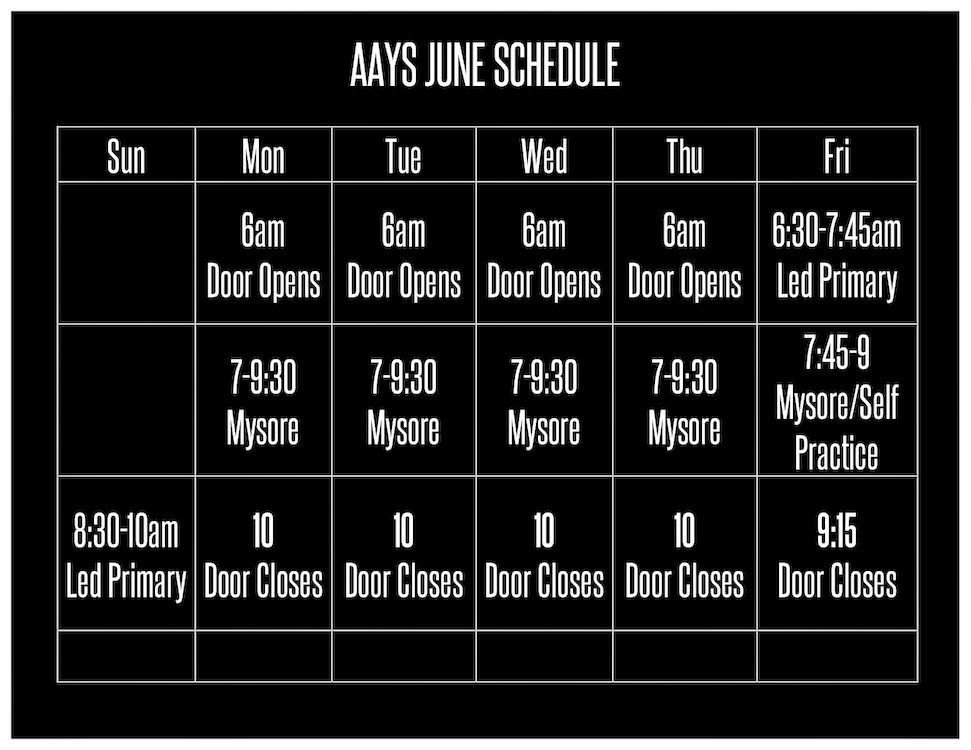
Summer schedule, how to get back in the game, and a short video intro with David Robson

http://www.ashtangayogaalbuquerque.com/


Q: I haven't been practicing... With the holidays, and work, and life, and the cold weather I just stopped. Now I dread coming back because I think it will be too hard and also I am a little embarrassed and disappointed in myself. Should I come back?

A: Yes, of course you should come back to practice! Practice is effort toward steadiness of mind. Don't worry about completing some acrobatic feat. What is really interesting, really what it is about is just showing up. So okay, you got a little distracted. You can have a fresh start tomorrow. In terms of asanas, just start small and slowly do a little bit more each day, couple of days, weeks, or even months. It depends on how long you took off... No matter. It will probably take some time for things to feel natural again and to get into the daily rhythm and that is okay. While time off is not recommended, the good thing about it is that when you start practicing again you'll quickly realize why you missed it so much and it will probably be more difficult to let it go again when life gets stressful. No fearing, you come!  (Original post here)


Read David's post on "ujjayi".

And learn more about initiating your practice.

Saturday, February 9, 2013

Weekend Edition #1


Eating to support your practice
Guy Donahaye
Ashtanga Yoga Shala NYC
http://bit.ly/VMCWpx


How to learn Ashtanga Yoga. Led class versus Mysore class?
Magnolia Zuniga
Mysore San Francisco
http://bit.ly/YMwMme


How to practice when hell’s freezing over
Angela Jamison
Ashtanga Yoga Ann Arbor
http://bit.ly/V4PXYP

The winds
Kate O'Donnell
Ashtanga 4 Life
http://bit.ly/14JDXiD


Food + Yoga
New segment on the blog on you guessed it, food!
http://bit.ly/VLoo4f


Check out
No Impact Man (book, movie, how-to's)
Vegucated (trailer, watch online)

Monday, January 16, 2012

Mysore Conference Notes: Practice, Food...

Conference – Asana as the Foundation of a Spiritual Practice – 1st January 2012
By Suzanne El-Safty
Posted 13 Jan 2012
Source suzanneelsafty.com

This conference was being filmed. This was also the day that I started to feel unwell – so I’m probably going to look very miserable and a bit green on film. Oh well! My notes are mostly okay I think but tail off towards the end as I began to feel worse and worse:

In Ashtanga Yoga we always do so many asanas. Not only in Ashtanga Yoga but in Krishnamacharya’s lineage in general. If we are following that lineage then there are lots of asanas. Many people have that question: why do we have to do asanas? Many teachers say that you don’t have to do asanas – you can just sit. But, if you see the yoga shastra - the Hatha Yoga Pradipika or even the Upanishads – they all say why asana is so important – to control our minds.

The Hatha Yoga Pradipika says that before we can think about getting enlightened we have to stabilise this body and mind. We have to practise asanas to stabilise our body and mind, to discipline this body and mind.

Now the mind is very chanchala – not in your control. The thought waves are so strong, the mind is like a monkey, a drunken monkey. To control the mind we need to bring some sort of discipline. You need to bring discipline to asana practice. It doesn’t come at once, you need to do for a long time – ‘sa tu dirghakalanairantaryasatkarasevito drdhabhumih’ (Yoga Sutras I:14). Asana is the foundation for the spiritual building; the foundation needs to be strong otherwise the building will fall. That is why asana is very important – it is the foundation to build the spiritual building.

It is only when you practise asana for many years that you realise how spiritual it is. To others it looks only physical. Other people who say that asana is just gymnastics, I call them sailors on the ocean – they don’t know about diving. They can’t see the beauty of the ocean – the colourful fish, the beautiful whatever animals you get in the sea. It is only if you know diving that you can see. Yoga is also like that – if you just sail on top of the ocean you will never get anything.

When you experience through the asana practice you can relish the purity of this practice.

Even in the Upanishads they talk about asanas. They compare consciousness to the sun. When the sun rises the rays of the sun are too harsh, at 12 o’clock they are too powerful; but as the sun sets it withdraws its rays and becomes very calm. This is like when a yogi sits in the third limb – in asana – he doesn’t have any mental disorders. We can feel that when we are practising everyday. We are totally concentrated on our mat – we forget all the nonsense happening around us. When we practise, day by day we get more focused, more concentrated.

Questions:

1) Which Upanishad was that?

Answer – the Kena Upanishad.

This system that we do, this vinyasa system, is very special. Only Krishnamacharya’s lineage knows this system. No one else knows this system. Three things are very important in this practice:

(i) Breathing

(ii) Posture

(iii) Gazing.

These are the three pillars which we need in our practice. I have not included bandhas – bandhas are to be done all of the time, not only in asanas.

For example, Surya Namaskara A has 9 vinyasas, this means 9 breathing techniques – 9 times you have to inhale and exhale. Surya Namaskara B has 17 vinyasas. Like this each asana has a certain number of vinyasas. This allows the breath to circulate in the body and activate the jatar agni (digestive fire). There are 72,000 nervous systems in the body – they must get purified – but how? by practising asanas with vinyasa.

The basic asanas – in the primary series – are very good to cure all diseases. Medical problems can be cured by doing the asanas in the primary series.

2) Should students put as much effort into the drishti (gaze point) as into say posture?

Answer – yes, these three things are very important. This develops your focus and concentration. So when you go to the next step – pranayama and dhyana (meditation) – these things will help you, they will help you to concentrate. This is dhyana what you are doing, it becomes like that.

3) Is a seated meditation practice then redundant in this system? or is it something we are striving towards?

Answer – first you have to understand what is meditation. Meditation is not something where you go somewhere, you close your eyes and sit. It looks very nice. But inside the mind is very disturbed – it goes to your country or to your boyfriend. First you have to control your sense organs. Then automatically meditation will happen within you.

First you need to bring the sense organs under control. That is why Patanjali says ‘yogascittavrttinirodhah’ (Yoga Sutras I:2) – yoga is to bring the sense organs under control. Once you still the mind – that is meditation, yoga or union.

For that we need to develop certain qualities within us. For this we have to practise certain asanas. I can go into a meditative mode when practising asanas.

Some people say they go to do a vipassana for 15 days, they go every day and they sit like this. For the first two days they have lots of enthusiasm; after the third day the mind starts wandering.

To reach the higher levels in practice first you have to build the foundation, that is asana, and then think about yama and niyama. It is a process which should happen day by day, year by year. A real yogi does not need a certificate saying he is enlightened. We have seen so many yogis in the past – nobody has a certificate.

4) When we practise, how do we keep a state of dhyana and also some awareness of where our legs and arms are?

Answer – that will automatically come. In practice your mind is thinking about your body – not about the nonsense outside. When I say kurmasana (turtle posture) your body will automatically do that. When we are practising our focus should be on our asana through our drishti and breathing.

When you are out on the street you see lots of street shows, like in Covent Garden. Like that in India we also have, lots of shows on the street – they are called games. In one game, there are two pillars and one rope between. One girl walks from here to there on the rope with 5 or 6 pots on her head and a bamboo stick in her hand. With hundreds of people watching. When she walks her mind is so concentrated on the pot. If she thinks about the people watching her she will fall and the pot will fall. See how beautiful that game is. Like that see the beauty of the asana.

5) If the purpose of the basic postures is to cure diseases then what is the purpose of the more advanced series?

Answer – to show off (laughs).

Primary Series is chikitsa vibhaga - to cure diseases. If yoga is used as a therapy then you do certain asanas to help, so that the body gets purified.

Then it gets more advanced – nadi shodhana (intermediate series is known as nadi shodhana) - to purify the nervous system. But nadi shodhana happens in all of the series.

In the advanced series there are lots of different postures – arm balances, back bends.

They allow you to see your limitations, in body and mind. When you are young it is easy to do all the postures. When I was young I used to practise for 3 hours – from 3.30am to 6.30am. Now I do just 2 hours.

6) Was the system designed by Krishnamacharya? or did Guruji design it?

Answer – Guruji put the asanas into different levels. It is the same thing he learned from Krishnamacharya, just more refined.

7) Can you talk about diet?

Answer – vegetarian food – that’s all. It is very good for the body. Non-vegetarian will give you stiffness, it will give you more muscle, that’s all.

8) What is the difference between doing lots of postures for 5 breaths each and fewer postures but for more breaths?

Answer - you can try both. If you sit in one posture then only certain organs will get exercise. If you do more postures then more organs get exercise. When you do more postures you generate more heat and the blood becomes warm and can circulate properly.


republished with permission
Tuesday, August 25, 2009

NY: Stinky Armpit or Steamy Tropical? (Under pressure)


The good, bad, and ugly post.

Right now, New York is a bit like both. It is a little too hot to feel comfortable walking more than a block but instead of having the permission to just bask in the steamy goodness, one feels compelled to pummel through. I find myself constantly echoing "so good" "yay summer" and "shorts!" It is the only way to find balance between the two worlds.

But really, right now I am a bag of excuses that should probably be stuffed into a sack with "sorrys". If I can't go to the early practice shift, I don't want to go at all because it is just so darn hot and sweaty. I admit it. I like the AC. At my house it gets the room to a bearable 80 (on a good day) with a lot less humidity. I've got a mild case of asthma, so I feel like I really feel that mush humidity/heat. I get annoyed with all the people heaving themselves around me. All that sweat (mine and theirs) gets thrown all over the place and when it is time for Mukta Hasta Sirsasana C I get agitated because my hands just slip all over like I'm giving the floor a massage. I just want to do my practice! I get mad a Guy for trying to get me to reach my full potential. I'm just happy I'm on my mat! I worry about my sternoclavicular joint, so I'm trying to be hyper-precise in my vinyasas. I feel like I don't have enough time in the day. I'm mad that I have to work...

What it comes down to is I am a little ball of cranky right now because I am a little stressed out about an upcoming GRE exam. I know it isn't that big of a deal, but I tend to put a lot of pressure on myself when it comes to academic achievement.


photo: http://thelittlechimpsociety.com/wp-content/uploads/2008/06/sweaty.jpg

Wednesday, August 19, 2009

Dear God,


It's me.  Are you there?

I'd pray when I was younger when there were things that felt completely out of my control.

A dog please.
Friends please.
Not to get caught please.

And yet, perhaps praying to God is a way of controlling the situation.  If I ask God, then clearly I have delegated a task to someone/thing who can get things done.  I've tossed a statement into a jar and sent it out to sea.  I have written a letter to Santa for presents and they better be the right ones otherwise I'll be stuck with a bunch of crap I don't want...

Asking God for stuff is making a choice that something is what I want.  At the time (back in the day) I'm sure I was talking to God the dude in the sky with the beard and I was this super-powerful earth goddess that totally connected with him.  I could talk to animals too.  Obviously.

I don't really pray like that anymore.  I think about God, but it is less like God my Big Brother and more like God the world is an amazing place.  I think about people and now and happiness and sadness and suffering and blessings.  I think about all this stuff crashing into each other in the middle of an intersection and that explosion in the center is God.  I think.

But today was different.  I had these intense internal moments during practice where I was there but then also sort of consciously decided to day dream that actually I was floating up to the sky and in Mukta Hasta Sirsasana C on a surf board zipping through the clouds.  And then I was thinking about blue bursts of light shooting up my guts and spine the color of blue 1980's dance/aerobics video lighting.  And then I was up in space flying around.  I just took my mind to this crazy place and giggled inside that no one in the room could have imagined that I was thinking about this stuff.

And it was also God.  It started with "God, I think that maybe today is the day that this crazy stuff is just going to snap my body in two".  And it turned into just "God".  God. God. God.  It gave me something to think about so I felt like I was busy or something.

But then after class as I dodged last night's puke on the sidewalk and hopped over puddles of dog pee, I thought about praying (or whatever).  "Um, so, hey God (or whatever).  Here's where I am at.  Give me a sign or something.  Okay, thanks."

I think that is it.


Tuesday, August 18, 2009

Kamikaze Practice -- from the crazy mixed up files of second series

stuff that should probably be marked as really private but whatever

... and some days I get this feeling of just... just dead.  Everything is dead and pointless and meaningless and a whole lot of complete bullshit and I really really just want to keep connecting with truth, reality, god, whatever.  

Drishti, flying, drugs, cliff jumping, tattoos, sex, heights, extreme sports, dancing, kamikaze practice.

Those headstands at the end of second are like that.  Some people are more suicidal than others.  I get a sick thrill out of just falling and then last second --bam!  Hands on the floor.  Bam!  Hands on the floor!  Bam!  That was loud!  Bam!  Fuck everyone in the room!  Bam! Alive! Bam!  Bam!  Strength, concentration?  Maybe just a whole lot of just me.  Just getting real small and sitting inside this body and laughing at all the crazy shit it does.  Getting a wild joy out of riding it into the sunset.  Trying to wear myself out so that everything else get in perspective or a little bit quieter and a little less immediate and important.  A bit like Fight Club...

"After a night in fight club, everything in the real world gets the volume turned down.  Nothing can piss you off.  Your word is law, and if other people break that law or question you, even that doesn't piss you off."

Wednesday, July 29, 2009

Big then small then big again

(originally posted at sanghayogashala.wordpress.com)

Even though all things are shades of grey, sometimes when speaking, we are forced to paint them black or white. It could be that we lack the time, words, pause, whatever the reason, a label has been placed and something is now something whether it was the way we saw it originally or not. Everytime we open our mouths or pick up the pen to speak, a bit of meaning is lost. Sometimes, however, there can also be an opportunity to look at the output as a more defined (even if crude) statement of what the root of something is.

Ashtanga is like this. It could be its cultural foundation, the absence of common language, or maybe it is just how it is supposed to be taught — simple and to the point. And in being economic with the statement, all the little parts and meanings come together to complete a big action. Of course sometimes although the statement is understood, the focus becomes the gathering of the little parts. “Jump!” leads to “how do I externally rotate this and what breath should I do that and where should I look?” instead of just jumping. Not showing up for practice breaks into I had to do this and then this happened so then I did this and then this instead of just realizing the time was not made to make something happen. It is really easy to just jump and it is equally as easy to get caught up in the million little pieces. Which is better? Which teaches and transforms us more? I think it is all shades of grey — a definite statement of black or white. It is nothing and it is everything. Sometimes things are very specific, sometimes they are broad. Sometimes it all makes sense, sometimes it does not at all.

Getting out of the language and into the practice can be an unsettling place. Reasons, excuses, and conditions are no longer valid. “Why” becomes “why not”. My practice is my practice and just like anyone else’s I settle into patterns and reasons and excuses and conditions. Meeting myself everyday, my same teacher, my same life, it is easy to also be the same. Slowly, I become something that I am allowed to be even if it is not my most maximum expression of possibility. And then something changes. A new teacher, a different breakfast, a new walk to work, and in an instant, I am confronted with the difference between where I am and where I think I am and have the possibility to be.

There was this transition between postures that was particularly challenging to me. Eventually I did it and then slowly felt that since I did it I didn’t have to do it everyday but could pull it out whenever I wanted to. Sometimes this is true, but it turns out that this was not like riding a bike or “hula-ing” a hula hoop. I was working with a new teacher and they looked at me quizzically when I didn’t take the transition. I then asked myself “why not” and spilled into a million little pieces and then decided that yes, “why not?” and tried. And tried. And am still trying to not think and just do because in this case, the grey is turning into white and I want it to be black because it can be. Because it starts as the grey and then things become black or white before we know it.

I think that this is what it is all about. Seeing, changing, transforming, becoming, and being. A constant big then small then big again. An endless cycle of being who you are, losing that, and then coming back again.

–Elise

(Video via youtube by govindakai of led intermediate series in Mysore, India at KPJAYI. Students are working on Karandavasana…)

Tuesday, October 7, 2008

Theta boy


"No afraid," Saraswati smiled up at me.
"Not today," I said. And I really meant it. I meant it so much that it was almost a joke that someone else made and it wasn't me freaking out yesterday.

I had taken my three wheels and three drop backs and was waiting with my arms crossed across my chest like a mummy for Sharath or Saraswati to come help me. Sharath was waiting to help someone else in back bends and I could see that he clearly was avoiding me. I'm glad he did, because I had unfinished business with Saraswati.

She took her time and came over to me. I felt strong, flexible, brave. I really integrated the idea that it wasn't Saraswati's back bend or even practice. No--it was mine and this is my moment and she is here to help me. So I pretended she wasn't even there. I back bended like I was going to do it all on my own and she was an extension of me. She grabbed my hands and put them on my legs and my heels stayed down and I felt strong. She walked my hands up and up and I straightened my legs more and more. And then she kept walking them and I kept straightening them until my hands were holding maybe my knees but it is hard to tell when you are backwards and upside down. My hands were almost even. I couldn't even remember a time when my left shoulder was bothersome. My legs were as straight as I've ever taken them and my thighs were on fire. My butt was on fire.

I was right on the edge and the sensations were insane. I felt myself get a little tired or a little afraid like when you back away from the edge of a cliff and in that moment something inside me said "no, I am not afraid" and I completely straightened my legs and everything just stacked up.


I felt Saraswati step away so that she was barely even touching me. I felt like I had fireworks in my pelvis or maybe a fish bowl swirling with koi and bubbles.I felt like those colorful blobs in that Bjork video were jumping inside me. I was there maybe for a few seconds, maybe a minute bu not longer. I stood up, shocked. Saraswati had a very serious face. I put my hands on her shoulders and just kind of looked at her. She nodded and gave me the best squish of my life. The funny thing is, my back was not tense at all. It felt great. I've never felt better. I pranced to the dressing room and took my finishing postures. I rested and went to another planet. I realized that yes, it is 99% practice 1% theory, but with time, you notice that actually it is also 99% mental and 1% physical.

Monday, August 25, 2008

What day is this?

Shattered-- that's how I feel. I somehow made it to the dressing room to do my finishing poses. I slapped down my mat and reclined. My eyes open, my eyes closed, the room spinning. I wonder if this is how a broken piece of glass feels. It is the same thing, only now in a different form. My back is split open like a nut shell like a orange peel, like a pomegranate, like an exoskeleton. Yes, that's it, I feel like a lobster. The room is still spinning. What happened in there?

Some people say that the pain will come and go. Some say that it will increase over time. Some that it will decrease. This pain is an indication of change. I'm changing. Growing pains. But is this really pain? It feels more like a train stopping abruptly. Or like when the ocean pulls you under. Or a deck of cards being shuffled. I'm not in pain, I'm just overwhelmed, I'm just trying really hard, I'm really just changing. There are no words for any of it, just confusion and experience and then already almost a month has past and I don't know what exactly I have been doing this whole time. I know time is passing because tomorrow is supta vajrasana.

Saturday, August 2, 2008

It's shala time! / my first day back at AYRI

My brain is having a hard time putting together cohesive thoughts and what does come out are bursts of jittery fragmented ideas with no transitions from one concept to the other. I think this is jet lag.

I went back and forth a bit yesterday--do I register or do I not? I decided to leave it up to the fates. If I got my pin number for my debit card right, I would go on and register, if I got it wrong, I wouldn't. I grabbed my bag and walked down the road to the shala passing through the day-long tree cutting project in its first stages (by the end of the day, it was all gone and in the process was complete chaos). Heavy limbs were falling, people were gathered around yelling "watch out!" and I was tip toeing over branches and leaves as a heavy limb fell a few feet behind me.

There is a man that always hangs out in front of the shala. You go to him and tell him what you need and he generally points you in the right direction with a grin. "Can I register?" He wags his head and motions for me to follow him inside the shala (which is also where Pattabhi Jois -- Guruji -- and his family live). "I need to get money first." He wags again and sits down. I walk around the corned to the State Bank etc. to try my luck at numbers. I'm rolling over the possible combinations. You see, I thought I had the pin written down, but threw it away in one of the mass purges last week which obviously wasn't the brightest moment in my career. I thought I new it, but the more I thought about it, was that 2 a 6?, the 8 a 0?, the 1 a 7?, and so on. I think about things visually and as I pictured the code scrawled on that paper, the numbers morphed form one to the other. I enter the atm room, shove the card in a few times, pound in the password too many times and get my card blocked. Great.

At this point, I'm pretty much set on practicing the following morning (Sunday) and so walk back to the shala and tell shala man that I broke my card and so don't have money but can I still register please? He makes a face that says it all and then tells me to go ask Sharath. I climb the infamous shala stairs, past clusters of havaianas to which I add my own and step into the waiting room/vestibule of the shala. The door to the shala is open and I step inside onto the massive area rugs. As I peek into the office, I see that there are many people gathered and decide that I better wait my turn. I pace in the waiting room for what seems like years until the other students come out and I head in.

First, I see Guruji who is sitting in the chair behind the desk wearing a skull cap. Sharath is standing next to him and offers me a seat. This is when I start spewing sentences and stumbling over my words like a drug addict in withdrawal. He tells me to come back the next day at 4:45am to register with the money. Now I really need to get the money.

I call the bank, I call everyone, I lose hope, it works out (thanks Kim), I get the cash, and then hit the hay at about 7pm and wake up this morning at 3:30am for practice/registration.

It is very quiet and very dark outside except for the occasional creak of a gate or slapping of a yoga student's flip flops on the way to class. It is important to realize before anything else that the clocks in the shala are about 15 minutes in advance, this is also known as "shala time". You walk through the dark alongside silent faces to the front gate and then you wait. By now it is 4:30am. By a quarter till, shala man opens the gates and the usually quietly composed and serene yoga students push each other like fiends up the stairs and squeeze through the doors to get a space. One might assume that there is a spot for everyone, however, not all spots are created equal.

The bum spots:
1. By an open window -- breeze and mosquito central
2. Next to a wall -- you have to move and re orientate yourself during some of the postures or risk running into the wall
3. By the bathroom -- the ceiling is low and some people can't extend their arms over their heads
4. In the dressing room and waiting room -- breezy, mosquitoes, and you're not really a part of the group
5. The hump -- the shala floors are made of marble (or is it granite?) and are covered with massive multi-colored area rugs. At the places where the mats layer one another, a hump is formed. When it is really crowded, your mat might be moved on top of this making practice very awkward, lopsided, and uncomfortable

My spot today? Next to Nuno (of Portugal) and Lea (Ashtanga Canarias) on the far left side of the room. I practiced here a bit last year and I guess that as far as spots go it was great!

After putting my mat down, I went straight to the office to register. I was relieved that Sharath didn't laugh in my face and say that he meant 4:45 in the afternoon. I sat down, filled out the application and promised to bring my photo and passport tomorrow. I gave him the shala fees (27, 530 rupees which is a huge stack of bills) and he filled out a registration card with my name, date, expiration, and mysore practice time of 7am. Nice! I flipped over the application to sign my agreement that I would not practice asana or pranayama with any other teachers in Mysore, stop when the teachers tell me, and there was one more stipulation but I don't remember what it was. Then, I gathered all my courage and asked Sharath about the poses from last year and how "it" works. One week of primary was his answer. So today I had the led class, then Monday through Thursday will be mysore style where I will practice primary series. On Friday and Sunday, I will go to the led first series class and then Monday I will practice mysore doing my full primary practice plus the second series postures I got last year up until Dhanurasana before I end with back bending and finishing poses.

Practice was electric. I was shaky, stiff, and slightly disoriented from the jet lag and days off from yoga. I sweat so much from all the traveling and from working so hard. Sharath teaches like no one else. Muscles become used and blatantly obvious in ways that I can never manage to create on my own. The hard moments were in utthita hasta padangustasana, navasana, sirsasana, and of course uthplutih. But I was proud of myself and how far I've come from last year. There is always a struggle, but at least I could keep up (twitching and all).

After practice, everyone heads outside for a coconut and then I headed home for a rest. I still am so excited that I am actually here!

Wednesday, July 16, 2008

Green Eggs

About 24 hours and $5.50 later I am sitting in a local coffee shop feeling really good about being in New York. It's that warm fuzzy tickle behind my sternum that makes me smile a little. Looking back, it's the same feeling I had walking across the Brooklyn Bridge for the first time and deciding that yes, this was where I wanted to be.

I break out the laptop and sip tea and here come my eggs and they are scrambled. But I hate scrambled eggs! But I didn't say anything. And I didn't get angry. The thought came up for a second and then it was gone and I took a bite and I liked them.

Before noon, the streets are still soft and if you have a chance to walk them and are able to look around, you notice all the many lives unfolding around you. A woman pushes a stroller. A bike passes by. People doing tai chi. Homeless kids laughing and passing a cigarette. Even the guy who turned suddenly stomping on my foot made me smile. I looked up and saw a man with his head out an apartment window. AC water dripped onto my head like sweet summer rain. Isn't it funny how you have to trick yourself into doing things differently and when you do, you're always surprised at how amazing it looks from the new angle.

"I'm barely helping you at all." Ha. Yeah right. It's a nice sentiment though. All those little details that you forgot you gave yourself permission to slide are now center stage when the visiting teachers come to town. Day one they watch you and take notes. Day two you get feedback and nod your head yeah yeah yeah. Day three you do. You do! You sadistic #&%#ers, #%&@ you! Day four you realize that maybe you aren't seeing yourself clearly (duh).

I've never watched myself practice. How can I be objective? How can I see the possibility? I can feel the kinks. It's so quickly that weeds overrun the flowerbed. We don't even notice they are there. And the gardener comes around and pulls and pulls and pulls.

Today I finally let out a sigh and said "okay". And I wasn't just saying it. Inside, my body said let's be open to the possibility. And now everything looks translucent.

Next post: A look at Ashtanga Yoga Immersions...

Tuesday, July 15, 2008

On Second thought...

Fuck this yoga shit.

(Don't mind her, this blogger is just working through some stuff in practice.)

Sunday, July 13, 2008

Ashtanga for life?

The long, drawn out, musings blog. But hey, it's a Sunday!

Is ashtanga really a life-long practice? Does it actually make people healthier? Why does it seem that everyone gets injured at some point, and how many long-term practitioners are still practicing ashtanga yoga as taught in Mysore?

Okay Jason, this one is for you.

Ashtanga yoga is "advertised" as a life-long practice. Let us first consider exactly what constitutes as the life-long practice. The Yoga Sutras say that "practice" does not refer only to asana, but to the "effort toward steadiness of mind". So although I might say that I'm going to "do my practice", I am probably referring to "doing my asana practice". Asana (poses) are only one segment of the complete ashtanga yoga system, so really, I am always trying to practice an effort toward steadiness of mind. I don't go into "yoga mode" for one hour and a half while I throw myself around on a cotton rug and then go outside to yell obscenities at each asshole who crosses my path. And what if I broke my arm? What would I do then?

But if it isn't about the asanas, then how about that quote that people love: "99% practice 1% theory"? What does this really mean? 99% doing vinyasas, 1% reading philosophy? 99% muscle, 1% brain? I think it's more like 99% moving toward stillness, 1% gathering more information on how to do that. (Although one could even argue that "gathering" is effort as well. I think the real point here is that one has to actually be actively DOING this stuff rather than just sitting around thinking about how maybe one day it will come knocking on the front door.)

So if our definition of practice includes much more than asana, then it is easy to imagine people practicing well into their nineties. Might Guruji be practicing asana right now in Mysore had he not gone through his tragic loss of a son? Who can say? Would Krishnamacharya have him doing asana to help his health problems? Maybe. We see many photos and videos of Krishnamacharya practicing asana and pranayama into very old age. But for whatever reason, as far as I know, Guruji does not currently practice asana. What his daily practice consists of I cannot say. Ask him when you're in Mysore...

Does ashtanga make people healthier? If we talk only about the asanas, we find that each asana has therapeutic benefits for the body and mind from helping to remove "bad fat" to massaging the liver to aiding constipation or urinary tract problems. The vinyasa method and ujjayi pranayama each have benefits as well. Additionally, the lifestyle surrounding ashtanga yoga asana practice and ashtanga yoga practice in general promotes healthy life choices. However, like anything else in life, it is about balance, and with a little bit of effort, we can easily overdo it.

The more I think about it, the more it becomes obvious that this system is only harmful if we make it that way and we tend to make it that way when we get really involved with the ego. For example, why would someone carry on an unhealthy form of extreme dieting unless they felt that it would make their practice better? (I want to "get" karandavasana so I'm doing macrobiotic fast number 7.) Isn't it possible to make gradual changes that are healthy or even to be patient and not obsess about progress? When does effort toward stillness become unhealthy or even dangerous?

So is ashtanga yoga a yoga of injuries and pain? We can break pain and injuries associated with ashtanga yoga into a few different categories. The first type of pain is associated with an injury that was already an injury before the asana and as we push ourselves into something (because we feel we have to accomplish it) the pain of the preexisting injury doesn't go away. The second kind of pain comes when we go deeper into something and discover a misalignment that was already there and as we work through it (because we want to perfect the asana) it causes us pain. The third kind of pain happens when we push hard to get into an asana and get injured because we weren't doing it properly or weren't prepared to practice it. The fourth kind of pain comes from faking the ability to practice a posture and getting injured when a teacher calls the bluff and adjusts us deeper or allows us to continue with what we are doing.

(This argument is tricky because on the one hand, without the fire of the ego that wants to find the stillness, we would be lying on our mats doing nothing, but on the other hand, blindly following the ego into uncharted territory and trusting the drive to be the best can lead us straight off a cliff.)

But maybe it is literally supposed to be a 6 day a week asana practice. Do all the old school luminaries still practice? If the previous discussion of pain and injuries holds true, then the only way to be able to sustain is to pull back and practice with humility and patience--which probably none of us really does. But we're trying though :)

The point? I think we just don't get it yet. As much as we say it, we can't figure out how to practice without thinking about the asanas. A trip to Mysore doesn't help. You'll hear me singing the "it's not about the poses" mantra soon, but even so, I think that students get injured in Mysore because they are pushing hard to get poses. It is what it is.

No one is forcing anyone to do anything. No one tells you that you have to do something if you don't want to. There are smart ways to work with and through pain and injury and there are really stupid ways to do it too. The question is not whether ashtanga yoga is a lifelong practice but whether or not we are up to the challenge.

Tuesday, July 8, 2008

"Ah ha!" Moments and Guess What? I Love Gymnastics

A few months back, I was busy pondering the difference between my back bends and what they could be. To review, my Iyengar friend Cory Washburn suggested that I "mull over" the concept of opening the back of my knee in drop backs. And mull I have in the hopes of obtaining more control and possibly that ever so lovely moment of suspension before delicately resting my hands to the floor and of course, coming up with no clear indication to the onlooker that that was what was about to occur: it was yoga magic. I knew that this would change a few things and require a shift in mind and body, but the idea of a "pain"-free and healthy back bend (productive back bending, really) kept me optimistic. I also knew that an indicator that I was if fact opening the back of my knee was being sore in my hamstrings and possibly belly instead of my quads and low back.

Almost two months later, I'm coming up from knee grabbing with legs straight and my butt on fire, my salambasana flying, lagu vajrasana a guarantee, and mayurasana becoming increasingly accessible. So there we have it--ah hah!

I don't remember what exactly compelled me to look up gymnastics on the internet, but somehow there I was googling away. Maybe it was the swimming trials on TV and I thought that watching gymnastics trials might be a great way to spend a rainy afternoon... Anyway, one thing leads to another and I'm watching youtube videos of elite gymnastics training. What I found particularly interesting was the number of tears, heartbreak, and toil behind the scenes movies that were listed. So it is hard. I get it. I love that people make videos of it. My favorite was a clip of this tiny girl maybe 8 years old in a supta padangustasana type position with her coach sitting on her extended leg while he pushed her raised leg with two hands into her face. She alternated between pushing her leg away and arms to the sides in exasperation, all in a fit of tears and agony. Wow.

I got to thinking about the similarities between the tears and toil in ashtanga practice and gymnastics and then between the two practices (and dedication to anything, really). There is quite a bit of hard work, frustration, and dumb and numb persistence involved. I know that even mentioning gymnastics on an ashtanga blog is controversial. Let's just get that out of the way.

Why would it be controversial? Well in case you're new, here's the rundown:
1. Because the origins of the hatha practice of ashtanga yoga are a bit vague. There, I said it. The original text that the practice is based on called the Yoga Korunta was eaten by ants, disintegrated, burned, vanished, etc. Some people say that it was a mix of yoga stretches, gymnastics, and wrestling exercises. Ashtanga people don't like this interpretation at all because it implies that the practice is very much based on practices that could be considered superficial in that they are based in the physical rather than the mental.
2. Because maybe people might think that I was a gymnast up until yesterday and so obviously this makes ashtanga yoga so easy for me and there is no merit in anything I do or say because I didn't have any tears or toil. I admit, I did gymnastics for a couple of years as a kid with Olympic dreams...REALLY big dreams. However, when I started yoga, I couldn't touch my toes. Now dancers are a whole other story...jk
3. Because if I'm entertained by gymnastics then I must hold a lot of merit in the physical aspect of practice and therefore am an asana-obsessed ego maniac. This one is true. ha.)

Now back to the gymnastics. I'm fascinated by the whole thing. The coaches, the grueling training, how strange it is to glamorize prepubescent girls, the eating disorders, the drama, the psychology, the voyeurism, just all of it. But most of all, I find it incredibly interesting that gymnastics is largely a kids' sport that destroys their bodies, while ashtanga yoga is extremely physically demanding, yet can be maintained for a lifetime and actually makes the body healthier. Where is the line drawn? Obviously, there is much more to this crazy ashtanga stuff than the poses.

Thursday, July 3, 2008

Hump day and related poses/Primary Series is like a treadmill set at "hills"

Thinking back to yesterday's practice and my body caught in a thick downpour of sweat, I try to recall what it was like to be a "beginner". I think it felt (physically) a lot like it feels right now. Some days I leave practice feeling like I took a nice nap or a warm shower; on other days, I feel like I fell off my bike, wrestled a bear, picked up a couch, or came down with the flu. When I was slowly working my way through primary, I remember feeling so tired that I couldn't even fathom coming in to practice -- the idea of rolling out my mat was already like practicing full primary. I fell on my face a lot. I did a lot of pep talks. My breathing was irregular. My bandhas were transient tenants. Overall, it was like visiting a country where I have never been, a language I could not speak, food I have never seen, with only one sort of friend to show me around -- sometimes.

Slowly, I learned how to pace myself, how to smooth out the kinks. I worked up the courage to challenge myself to do a bit more than just show up (which is already like 80% of the practice for a college student). Things started to make sense and integrate into my body and mind. But even as the storm began to pass, even as I began to converse with the locals (in horrible grammar and accent, of course), I had certain "mantras" going through my mind. During the Sun Salutes at the beginning, it was "Crap! Three more, one more, etc." After that hill was climbed, it was "Here it comes--utthita hasta--here it comes!" And could I time it perfectly so someone will hold my leg? After that, I was coasting, arms spread to the sides, sea breeze in my face -- until I realized that navasana was only a few poses away. Then it became an effort to slow down my breathing and enjoy the forward bends (five breaths is never enough).

Navasana always comes, regardless of how much one tries to avoid it. Bent legs, sweating, wrinkled and pained expressions abound. And then bhujapidasana, kurmasana, with relief finally coming in garbha pindasana. From there again, it is coasting until back bending, sirsasana, and of course, uthplutih.

I was always fascinated by this pacing in primary series, how it is not a steady incline or decline, but a series of "highs" and "lows" punctuated by the "really hard shit" in the middle (navasana, bhujapidasana, kurmasana, and to some extent garbha pindasana). Now when I mean "hard", I mean that these postures demand a combination of strength and flexibility, and one's ability to "perform" them after doing a lot of things that take a lot of effort and also doing them every day, consistently. Yes, there are many challenging moments in the first series, but this cluster of poses can either make or break you, they take no prisoners, there is no faking it, you either have it or you don't. The thing is, you might peek your head up over these "hump poses" that split primary in two for a moment and see what asanas follow and think "I can do those! Those are easy! Why can't I just to them?" This is the magical moment where you either push through and figure it out, give up, or stay where you are for a long time.

I am finding that second series is much like this. Once I was used to primary and became "proficient", or whatever, the sweating stopped. The poses of second series which I began to practice were fun. I left practice every day energized and feeling like I could do even more. It was sweet while it lasted. Soon enough I came to realize that there were "hump poses" in second series as well--tittibhasana, pincha mayurasana, karandavasana, mayurasana, nakrasana. Although I am practicing up until mayurasana, I know nakrasana will take some mental strength, but over this fence, the grass looks fairly green. I wonder if eventually it will feel how primary feels now: like an old friend. That will be the day. For now, I am covered in sweat, slowly peddling up a mountain.

Friday, June 27, 2008

Life's little lessons

Why on earth would I care whether or not my students waited for my count before moving into upward dog from chaturanga?  

I ponder this question in the fallout of the collision between the "yoga class world" and the "real world".  

You see, substitute teaching is the worst, regardless of what subject you teach.  When I explain my distaste to a doe-eyed and bushy-tailed potential sympathizer, I am always met with confusion.  I know, I know, it's just yoga.  How bad can it be?  You tell people what to do, they listen because they want to learn what you are teaching and then we all have a nice savasana and herbal tea at the end.  I admit, some days are like this.  And some days, they really aren't.

Without exhausting the subject, let's just say that substitute teaching a led ashtanga class can be a nightmare.  The worst scenario?  A one-hour lunch hour class through navasana (half primary).  Why?  The class is scheduled at this time to cater to people who work, meaning that people are in "go mode" and you can expect random drop-ins from people with little to no experience with yoga, and definitely not ashtanga.

But it is a "led" class so isn't that better than the self-led "Mysore"?  Wouldn't that be good for beginners to hear what to do?  Maybe in a perfect world.  But this is a class I'm subbing which means that regulars will expect to be led through navasana and the newbies will have no extraneous explanations of what they are supposed to do.  Good luck.

Now remember again that I am subbing, so already the students are suspicious.  Add onto that the fact that I don't fuck around.  Chatvari means chatvari.  And now we are back to the original question of why do I care and why does it matter?

This got me thinking of my Japanese sculpture teacher back in art school.  He walked up to Eric, nodded his head in approval, then raised his hand and proceeded to beat the clay bust with a mallet.  He encouraged us all to do the same with our "masterpieces".  "You want to fire this piece of shit?" He asked the girl he fondly referred to as "Miss Piggy".  Yes, he was mean.  Yes, he was right.  

Beginners are the best students.  They are totally receptive to what you have to say.  You can instantly see the changes in body and mind as they come in quick bursts of intelligence.  They are humble.  They still can laugh.

Advanced students are the best students.  They are totally receptive to what you have to say.  You can see them as they work to integrate the verbal and physical cues into their practice with the intelligence that comes with experience.  They are humble.  They remember to laugh.

It is everyone in between who is hit or miss.  They are like rebellious teenagers who know everything and will never die.  They refuse to slow down for the beginners, they insist on spying and trying what the advanced students are up to, and they firmly believe that everyone in class should have the exact same pace as their breath.

As a teacher, this means a whole lot of pulling the breaks, holding back, curfews, and the moment where you have to decide if it is worth it.  

Option 1:  Just don't look.  Convenient, less exhausting, but hard to do if you care.
Option 2:  Calling them on it.  But you have to be willing to stand your ground.  Stand your ground?  In a yoga class?  Yep.  Sometimes it means saying to a student that if they aren't here to take the class I'm teaching, they need to leave.

This sucks, feels horrible, turns my face pink, makes my ears steam, and generally is not fun.  But--it is these students who usually come back.  Afterwards, I'm exhausted and upset, they are coming up to me saying "great class!"  

Sometimes when I go in to teach class, it feels like we have stepped into an alternate universe and there are no longer people, just samskaras flying around.  Ultimately this is my practice too and the most difficult students and classes are the best teachers. 

Tuesday, April 29, 2008

Sudoku saves the day

"I am just so frustrated that sometimes I want to cry"

Nope, those weren't my words this time, but a student of mine.  I reassured them that this is normal, that this comes up, that I experience this, and in fact, experienced it just a few days ago.  This practice is about so much more than the physical.  It is a daily therapy session.  (This is why the more I think about this line...

"Today, the style [ashtanga] appeals to Western devotees whose priority is a high-energy workout rather than an inner journey."

...From the April 23rd article in Time by Madhur Singh, I get so annoyed at how some people just don't get it at all.  If I was in this for the bikini body, I'd save a lot of time and energy by just getting a gym membership.  I'm sorry, but what a jerk.)  

And now, here I sit, almost ten hours later, feeling the same way as my student from this morning.  I feel frustrated, but mostly inadequate, or even unheard or unrecognized.  These are all pretty silly things to be feeling, but the practice is bringing them up.  Mostly the inadequacy one.  That is a hard one to admit.  I'm not really sure what to do with these feelings.  I have been able to step back and hold them in my hands, but now I don't know if I should toss them and run, hide them behind my back, pour them over my head, or put them in a jar.  So far, I've been hiding them behind my back, but the thing is when you do that, you know that they are there burning a hole in your pocket.  

I can't help but think that perhaps they are tied to something else going on like the planning for India and feeling a mixture of excited and scared.  I don't know.  I just feel confused and kind of useless and worn out.

Maybe its control issues.  I feel like I am losing control of a lot of things in my life right now and the one thing I had a bit of a grasp on was practice, all neat and folded in a tidy little drawer.  But now with such intense work on those last few poses, I feel like I end with rough edges and the "high note" is frazzled.  

So there's that.  There's not knowing what will happen with my relationship when I go away.  There's feeling like I'm making the wrong decision.  There's fear of the unknown and messing up.  There's fucking George Bush on TV today acting like an asshole.  I mean he looked so nervous and was so unprepared that I just felt bad for him and disgusted with us for not doing something about it,  but ultimately helpless because there is nothing to do.

And then there is sudoku.  A ray of hope.  I always thought these things were so stupid.  Then I tried to understand how to do them and just couldn't be bothered.  And then I sat down and tried to do one and kept messing up one after the other.  And then, this week, I completed one.  And now I can do them.  They are challenging, but not impossible.  You just need patience...Is a moonday coming up or what?

Sunday, April 27, 2008

How NOT to do karandavasana and other lessons learned when going from pc to mac

I don't know that I was born a pc person.  We've had a couple of old macs in the past.  But it just turned out that I always seemed to have pcs around.  So, I got to know them well enough.  I knew the little shortcuts and some better-than-average problem solving techniques.  I feel comfortable turning on a pc, knowing that I can figure them out.  I understand their language, or at least I understand my own limitations within that language.  

I just got a mac.  Knowing how confident I am with pcs, I didn't give the conversion much thought.  It would be easy.  And it was... sort of.  We said "hi" to each other and exchanged a few simple courtesies like "where are you from", etc.  But once we tried to carry on a deeper conversation, I quickly realized that we weren't understanding each other too well.  It's kind of like speaking to someone who speaks your language, only with an accent that makes it nearly impossible to understand them when they get comfortable and begin speaking faster like they do with their friends.  

So how does this relate to yoga, and in particular, karandavasana?  Well, you see, I have an ipod and for whatever reason, they make it really difficult to transfer your library from one computer to another.  Now this is something I've always accepted.  But now that I have a new computer and I'm recycling the old one, I feel like this is completely unjust and that their must be a way.  Many failed attempts later, I've got it!  I figured it out!  Useful tool: "How to transfer itunes library to new computer".

This pc to mac transition has been challenging.  One thing after another has been like this.  But just as the ipod should be able to transfer info from one place to another--a conduit for information, if you will--the lessons from life and yoga seem to reflect the other.  I think I am saying that I'm an ipod.

Anyway--
So, just as I'm learning about and facing this new challenge of mac "usership", I am also learning about and facing this new challenge of karandavasana (or new pose) "usership".  For example, day one of mac, I couldn't figure out how to connect to the internet, flipped out, and then waited patiently for help.  Day one of karandavasana, I couldn't figure out to connect with bandha, breath, drishti, flipped over, and then waited reluctantly for help.  I feel like the ability to recognize a limitation, walk away when required, and patiently work toward a solution, are all skills and attributes learned from yoga practice and learning any new skill.  I feel like the ability to learn something new, tackle the unknown, and keep an open mind are all being cultivated when learning a new skill (such as using a mac) and from yoga practice.  

The point-
Nothing is impossible.  It might take time, but there is always a free software program out there that will give you what you need to figure it out to make it work.  But first, you kind of have to figure out what doesn't work.

How not to do karandavasana
1.  Loose your tristana (bandhas, breathing, drishti)
2.  Think
3.  Kick like a weakling, weenie
4.  Kick like a maniac
5.  Give up
6.  Cross your legs loosely
7.  Stick out your ribs when going down (although this is okay for some people--but this is my list!)
8.  Give up
9.  Stick out your ribs when coming up
10.  Give up
11.  Noodle legs
12.  Give up

No one was born doing padmasana or any other pose, for that matter, straight out of their mother.  No one was born mac or pc.  Time, patience, practice, we can all be multiple computer ipods.